
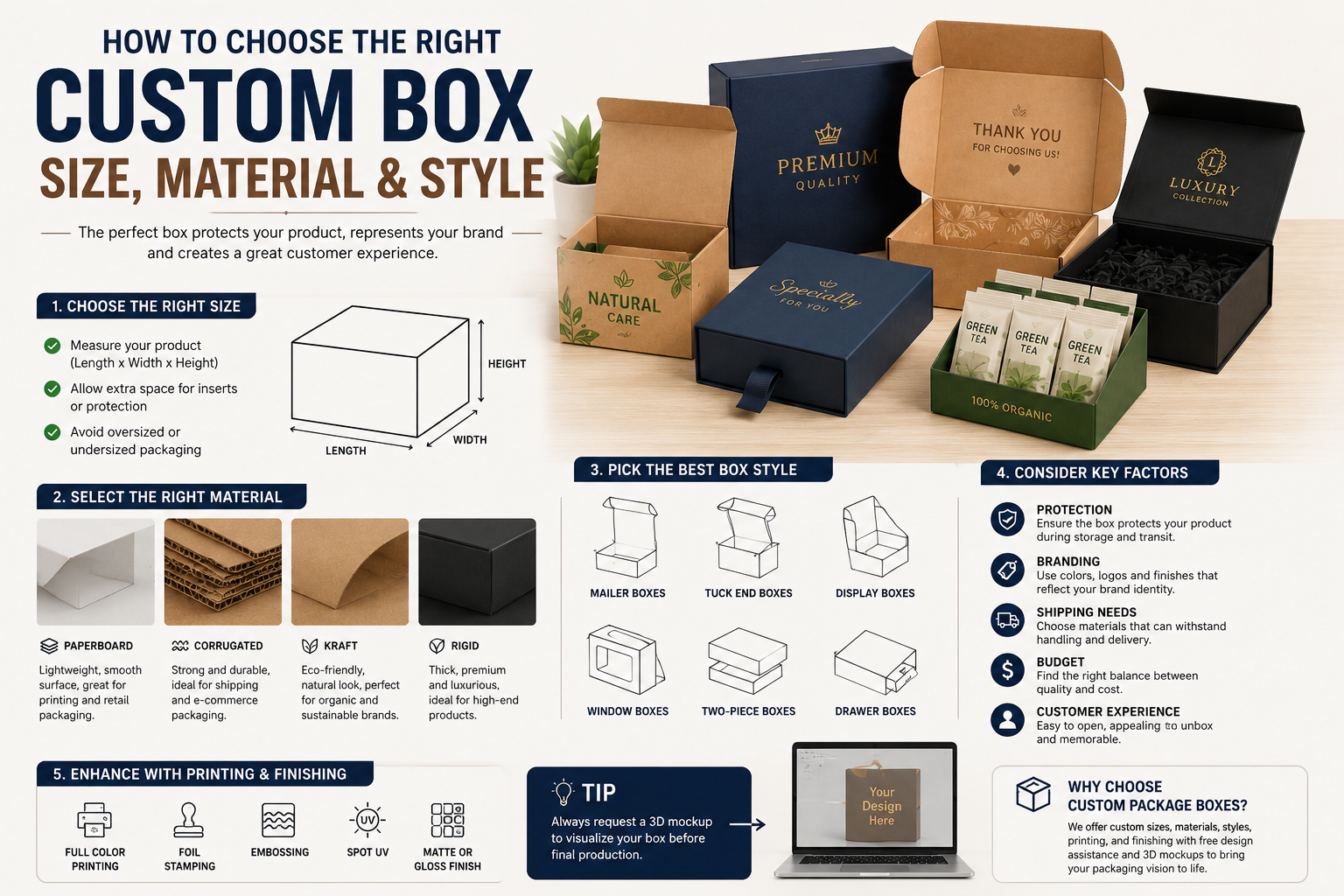
Introduction
Choosing packaging for a product involves more than selecting a box that looks attractive. The right packaging needs to fit the product properly, provide suitable protection, support your brand, and work well for storage, shipping, and presentation.
With so many packaging styles and materials available, selecting the right option can feel overwhelming. Understanding the key factors can make the process much easier.
Whether you’re launching a new product or upgrading existing packaging, choosing the right custom box size, material, and style can help create packaging that works for both your business and your customers.
Why the Right Box Matters
Packaging affects several parts of the customer journey.
A properly sized box can help keep a product secure. The right material can provide the required level of strength and presentation. An appropriate box style can make opening, displaying, and storing the product easier.
On the other hand, packaging that is poorly designed may result in unnecessary space, insufficient protection, difficult opening, or an appearance that does not match your brand.
Start With Your Product Dimensions
The first step is to understand the exact dimensions of the product.
Measure the:
- Length
- Width
- Height
- Weight
If your product requires an insert, protective material, or additional components, include those requirements when determining the internal dimensions of the box.
The goal is to create enough room for the product while avoiding excessive empty space.
Avoid Oversized Packaging
A box that is significantly larger than the product can create several problems.
Extra space may require additional filling material to prevent the product from moving. Larger packaging can also take up more storage space and may be less convenient to handle.
Custom sizing allows businesses to create packaging that is closer to the actual product dimensions.
This can improve presentation while making the package more practical.
Avoid Packaging That Is Too Small
Packaging should also provide enough room for the product and any necessary protective components.
If a product is forced into a box that is too small, the packaging may become difficult to close and the product may be exposed to unnecessary pressure.
Before finalizing dimensions, consider the complete packaging system rather than measuring the product alone.
Consider the Product’s Weight
Weight can influence the type of packaging material and construction you need.
Lightweight products may work well with certain paperboard packaging styles, while heavier products may require stronger materials or structures.
A packaging supplier can help you determine which material and construction are appropriate for the product’s weight and intended use.
Think About Product Fragility
Fragile products require more consideration than durable products.
Glass, ceramics, electronics, cosmetics, bottles, and delicate accessories may require internal inserts or additional protection.
Custom packaging can be designed with compartments, trays, foam, paperboard inserts, or other structural features depending on the product.
Choosing the Right Packaging Material
Different packaging materials provide different characteristics.
Your choice should depend on:
- Product weight
- Fragility
- Shipping requirements
- Desired appearance
- Storage conditions
- Budget
- Brand positioning
For example, a premium cosmetic product may prioritize presentation, while an e-commerce product may place greater emphasis on shipping protection.
Paperboard Packaging
Paperboard is commonly used for many retail and consumer product boxes.
It can provide a clean printing surface and can be customized with different colors, graphics, and finishing options.
Paperboard packaging can be suitable for products where lightweight presentation and branding are important.
Corrugated Packaging
Corrugated packaging is often selected when greater shipping protection is required.
Its layered construction can provide strength and durability, making it useful for e-commerce shipments and products that need additional protection during transportation.
The appropriate corrugated structure depends on the product and shipping requirements.
Kraft Packaging
Kraft packaging offers a natural and distinctive appearance.
It can work particularly well for brands that want a minimalist, handmade, organic, or sustainability-focused visual identity.
Kraft boxes can also be customized with printing, windows, logos, and different structures.
Rigid Packaging
Rigid boxes are designed for a more premium presentation.
Their sturdy construction makes them suitable for products such as:
- Jewelry
- Cosmetics
- Watches
- Fragrances
- Gifts
- Premium accessories
Rigid packaging can also incorporate magnetic closures, custom inserts, and premium finishing.
Choose the Right Box Style
Box style should be based on how the product will be packaged, presented, opened, and used.
Some popular options include:
Mailer Boxes: Useful for e-commerce shipping and branded deliveries.
Tuck-End Boxes: A practical option for many retail products.
Rigid Boxes: Suitable for premium products and luxury presentation.
Display Boxes: Designed to showcase products in retail environments.
Window Boxes: Useful when customers need to see the product.
Two-Piece Boxes: A classic option for gifts and premium products.
Consider How Customers Will Open the Box
The opening experience can influence how customers perceive the product.
A simple tuck-end structure may be ideal for everyday products, while a magnetic or drawer-style box may create a more premium experience.
Consider how easy the packaging should be to open and whether you want the opening process to feel quick, practical, or luxurious.
Match Packaging With Your Brand
Your packaging should feel like part of your overall brand.
If your website uses minimalist design, your box could use clean typography and a simple color palette.
If your brand is playful, colorful graphics and creative illustrations may be more appropriate.
Premium brands may benefit from sophisticated colors, textures, and finishing options.
Consistency helps customers recognize your products more easily.
Consider Printing and Finishing
Once you’ve selected the structure and material, think about how you want the box to look.
Possible options can include:
- Full-color printing
- Logo printing
- Matte finishing
- Gloss finishing
- Foil stamping
- Embossing
- Debossing
- Spot UV
You don’t need to use every available option. Select the features that support your brand and product positioning.
Think About Shipping Requirements
If your products are shipped directly to customers, packaging needs to withstand the delivery process.
Consider the distance products will travel, handling conditions, product fragility, and whether the package needs additional internal protection.
For e-commerce businesses, packaging should balance presentation with practical shipping requirements.
Consider Your Budget
Packaging decisions should also fit your business budget.
The most expensive packaging is not necessarily the best packaging. The right solution is one that provides the appropriate protection and presentation while making sense for your expected order volume.
Businesses should consider both the per-unit packaging cost and the value that improved packaging can provide through branding and customer experience.
Request a 3D Mockup Before Production
A 3D mockup can help you visualize what your finished packaging may look like.
It can make it easier to review:
- Box proportions
- Logo placement
- Colors
- Artwork
- Product fit
- Overall presentation
Making design adjustments before production can help you achieve a better final result.
Why Choose Custom Package Boxes?
Custom Package Boxes provides packaging solutions that can be customized according to product size, style, material, printing, and finishing requirements.
The company also offers design assistance and 3D mockups, helping businesses visualize their packaging before moving forward with production.
Whether you need mailer boxes, retail packaging, kraft boxes, rigid boxes, display packaging, or another custom solution, selecting the right combination of size, material, and structure is an important step.
Final Thoughts
Choosing the right custom box requires careful consideration of your product, brand, customers, shipping requirements, and budget.
Start with accurate product measurements, determine the protection you need, select a suitable material, and then choose a box style that supports the customer experience.
When these elements work together, your packaging can protect the product while strengthening your brand and creating a more professional presentation.
Need help choosing the right packaging for your product? Contact Custom Package Boxes to explore custom sizes, styles, materials, printing, and finishing options for your business.